Jun. 24, 2026
High-end beauty and skincare counters serve as the core touchpoint for offline brand conversions. However, many retail brands face severe budget overruns or sub-optimal fixture textures due to a lack of precise upfront cost planning. Deploying a premium, illuminated cosmetic display stand requires balancing aesthetics with financial reality. This guide breaks down the standardized budgeting methodology for retail display procurement—covering commercial scenarios, structural cost items, brand positioning alignment, and long-term return on investment (ROI) calculations.
Establishing a baseline allocation begins with analyzing the target retail deployment environment. Commercial store fixtures generally fall into two distinct budget tiers based on their intended lifespan and structural demands:
Short-Term Pop-Up & Promotional Displays: Designed for rapid seasonal product launches or short-duration event marketing. These structures rely on lightweight configurations and simple acrylic setups without complex internal electronics. Sourcing teams minimize upfront development capital here to align with short merchandising cycles.
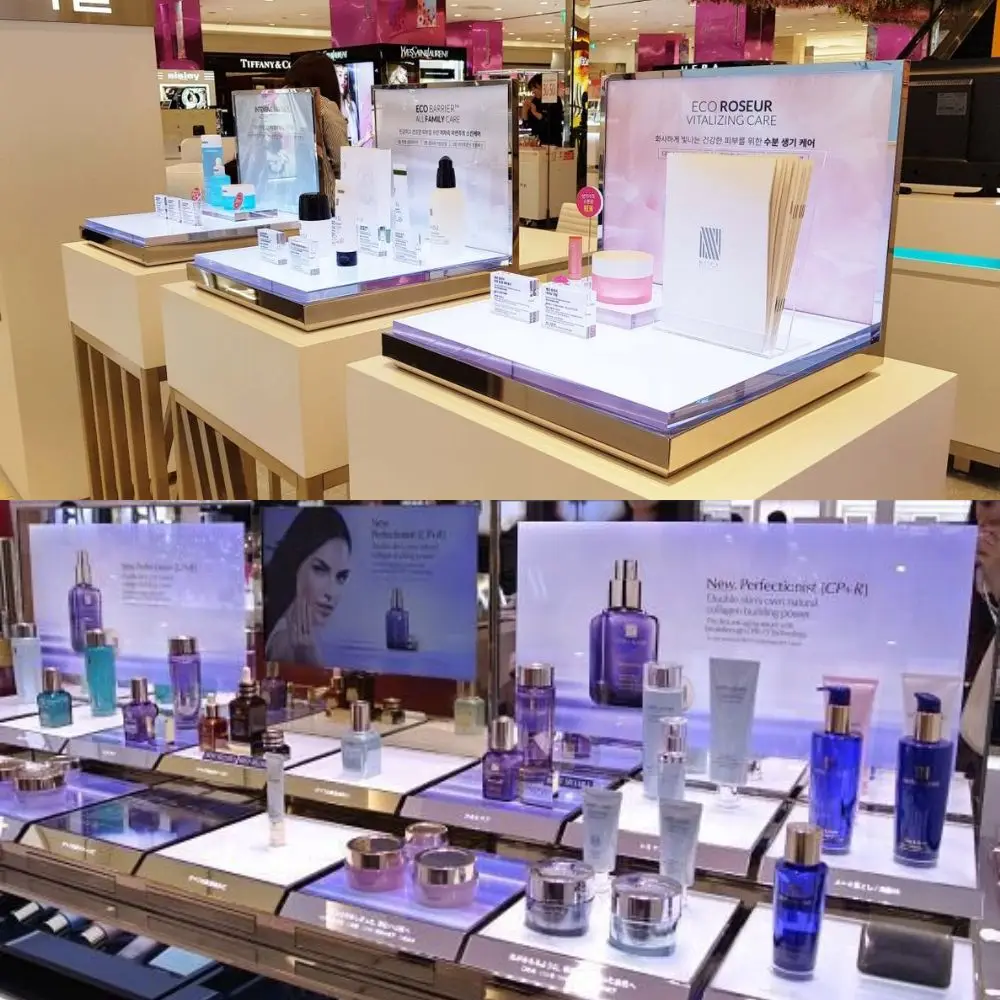
Long-Term Department Store Counters: As seen in luxury multi-brand retail environments, these heavy-duty illuminated platforms demand premium thick-walled cast acrylic substrates, integrated LED backlighting, durable metal trim reinforcement, and permanent high-fidelity UV branding graphics. Engineered for a operational lifespan of 3 to 5 years, these installations justify a higher capital allocation per unit due to their continuous customer-facing roles.
To prevent cost creep, supply chain managers must isolate the core engineering components that drive the factory-level bill of materials (BOM):
Main Body Material Budget: High-transparency thick acrylic panels and specialized metal edging constitute the primary structural cost. Material gauge and substrate grade directly dictate baseline pricing.
Integrated LED Lighting System Cost: Even illumination across the display surfaces requires dedicated light guide panels, calibrated diffusion layers, certified low-voltage LED ribbons, and specialized internal wiring pathways. Complex electrical integration increases engineering hours.
Custom Brand Graphic Printing Expense: High-definition graphic integration—including backlit film inserts, interchangeable poster slots, and precision multi-color brand logo printing—scales based on total decorative surface area.
Assembly & Craft Labor Cost: Specialized fabrication techniques, such as diamond edge polishing, custom thermal bending, multi-material bonding, and rigorous quality control testing, dictate the overall labor cost allocation.
Packaging & Shipping Budget: Large-format cosmetic display stand units require custom drop-tested protective crating with high-density foam inserts to mitigate international transit breakage, which must be accounted for in total procurement budgets.
A brand's market placement directly defines its fixture tolerance limits. Premium luxury skincare and cosmetics brands allocate significant resources toward heavy cast acrylic components, uniform high-lumen backlit diffusers, and brushed metal borders. This capital layout ensures the in-store presentation matches high premium tier branding, protecting the retail environment's overall visual integrity.
Conversely, mass-market drugstore cosmetics lines focus on maximizing unit volume while controlling costs. These layouts utilize streamlined single-tier configurations, standard acrylic gauges, and simplified silk-screen graphics to allow broad regional rollouts within tightly constrained supply chain budgets.
Sourcing teams must weigh initial non-recurring engineering (NRE) costs—such as technical prototyping and custom molding—against long-term field performance. Investing in robust material grades ensures store fixtures withstand high-traffic commercial environments without premature yellowing, scratching, or electrical failures. Selecting cheap, unverified material variants frequently results in secondary replacement costs, ultimately inflating the total cost of ownership (TCO) across the retail rollout lifecycle.
Procurement teams can optimize capital efficiency by utilizing standard scale production strategies. Consolidating regional procurement allocations into centralized volume contracts allows factories to maximize material yields and reduce unit-level manufacturing labor overhead. Furthermore, implementing modular component engineering allows swift in-store graphic updates or isolated part replacements without requiring complete fixture disposal, significantly lowering ongoing operational maintenance costs.
Q: How do material thickness and grade impact a cosmetic display stand quote?
A: Thick-gauge virgin cast acrylic provides optimal optical transparency and structural rigidity required for department stores, whereas thin or recycled material reduces structural lifespan and lowers upfront material costs.
Q: What are the engineering benefits of integrating automated LED systems?
A: Calibrated LED lighting strips combined with dedicated diffusion sheets prevent visual hot spots, delivering smooth illumination that enhances product clarity on retail shelving.
Q: Can structural configurations be optimized to minimize international freight costs?
A: Yes. Developing modular knock-down (KD) structural engineering minimizes overall packaging volume, reducing total ocean and land freight expenditures during large-scale global shipments.
Q: Where can I review more technical engineering details for commercial display units?
A: Please access our dedicated manufacturing FAQ directory for in-depth insights into retail fixture engineering and quality metrics.
Successful retail display budgeting requires clear alignment between visual merchandising intent, material specification, and factory-level production capabilities. As an established global store fixture manufacturer, TERMEIN Display optimizes commercial procurement via our comprehensive dual-facility manufacturing footprint. Operating a 25,000 m² production facility in China alongside a flexible 5,000 m² factory area in Vietnam, we utilize over 100 advanced machining setups and more than 160 specialized technicians to deliver high-capacity throughput exceeding 1,000 units daily. This diversified multi-regional infrastructure enables reliable large-volume manufacturing, ensures consistent build quality, and guarantees on-time delivery schedules for complex international brand rollouts.
Looking to align your premium store display aesthetics with precise procurement cost efficiency? Contact our engineering team for a detailed line-item cost analysis and scalable production quotation tailored to your retail budget targets.
Custom SolutionHidden Costs in Cosmetic Display Stand Manufacturing You Should Know
Why Cosmetic Display Stand Prices Vary Between Manufacturers
Latest News
Jun. 24, 2026
Why Cosmetic Display Stand Prices Vary Between Manufacturers
Jun. 24, 2026
What Factors Affect Cosmetic Display Stand Manufacturing Costs
Jun. 24, 2026
Jun. 17, 2026
Freestanding vs Countertop Cosmetic Displays: Which One Fits Your Retail Space?
Jun. 17, 2026
10 Cosmetic Display Design Ideas to Enhance the In-Store Shopping Experience
Jun. 17, 2026
How to Choose a Reliable Cosmetic Display Manufacturer for Your Brand
Fulfill Your Custom Desires
01. Demand confirmation
02. Initial quotation
03. 3D Effect confirmation
04. Sample production
05. Sample effect confirmation
06. Bulk order production
07. Quality inspection
08. Shipment
:
Mob.: +86 166 7095 3112
Email: sztemei27@sztdp.com
WhatsApp: +86 173 1806 7256
WeChat: 16670953112
China Factory: Shenzhen Termein Display Products Co., Ltd.
China Address: Building B1, Anda Industrial Park, Fenggang Town. Dongguan City, Guangdong Province, China.
Vietnam Factory: CÔNG TY TNHH SẢN PHẨM TRƯNG BÀY DISPU ( VIỆT NAM )
Vietnam Address: B4 Địa chỉ Thửa đất số 60, tờ bản đồ số 40, Ấp Cầu Sắt, Xã Lai Hưng, phường bến cát, thành phố hồ chí minh,Việt Nam.
Quick Navigation
Custom Vape Display