Jun. 24, 2026
Minimum Order Quantities (MOQs) serve as the primary factor governing commercial factory quotes for a custom cosmetic display stand program. While visual presentation teams often prioritize aesthetics, supply chain managers must understand that production volume directly influences manufacturing cost structures. Advanced fabrication techniques—including CNC milling, specialized laser-cutting guides, and complex layered wiring—require significant initial setup investments. Understanding the relationship between order volume and manufacturing efficiency helps retail procurement teams optimize their sourcing strategies and reduce per-unit costs.
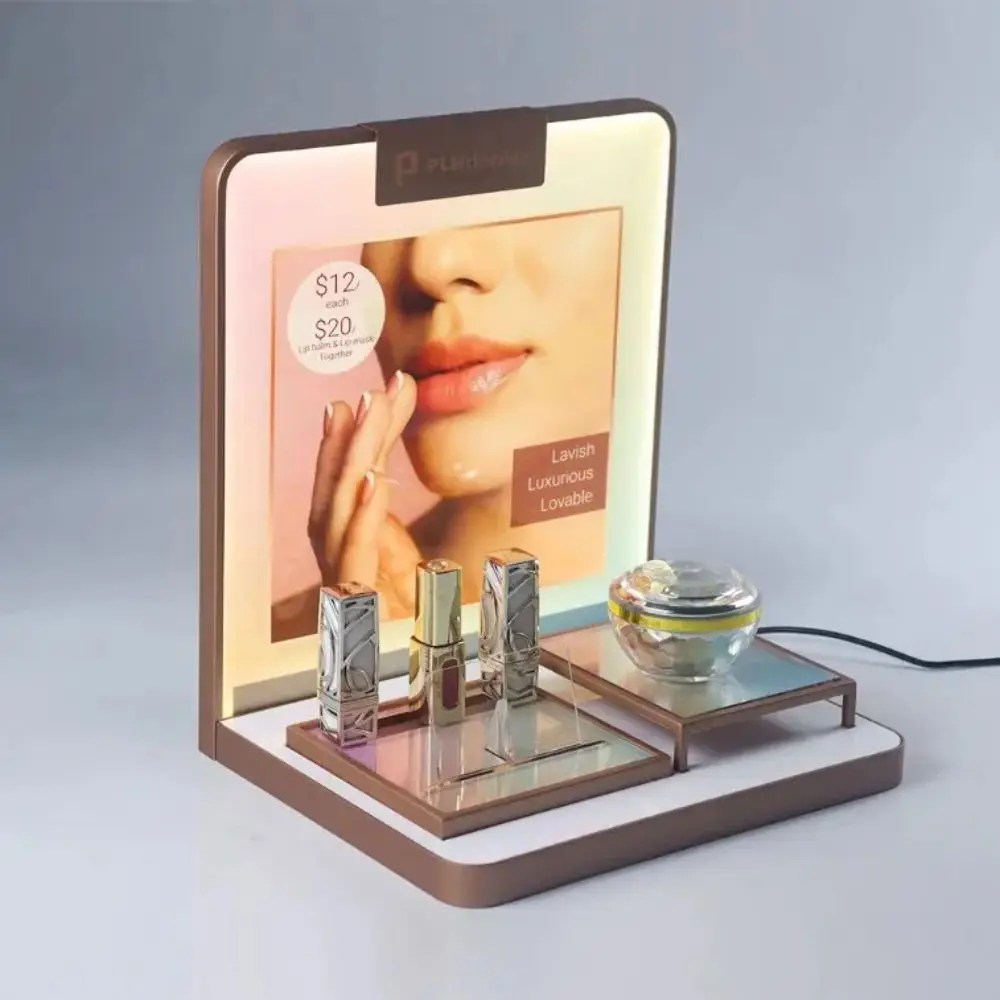
High-End Illuminated Cosmetic Counter Unit Incorporating Multi-Material Assembly ElementsDeveloping high-end retail fixtures with specialized attributes—such as custom curved metal profiling, multi-step layered presentation steps, and built-in LED backlighting diffusion matrices—requires unique tooling configurations and dedicated assembly jigs. This upfront engineering investment significantly impacts pricing based on order volume:
Low Order Volumes: When purchasing small batches, the total cost of custom molding, prototype engineering, and laser paths must be absorbed by a limited number of units, causing the single-unit price to spike.
High Order Volumes: For mass production runs, these fixed tooling and preparation fees are amortized across thousands of units, reducing the per-unit mold expense to a negligible fraction of the total cost.
This lighted cosmetic display with an exclusive irregular frame requires dedicated molds, making small orders much more expensive per unit. Sourcing teams must account for this mold amortization cosmetic display stand small MOQ variable during early budget forecasting.
The total volume of an order determines the factory's purchasing leverage when securing raw materials. Premium counter installations utilize a variety of advanced materials, including thick high-purity cast acrylic sheets, electroplated metal trims, commercial-grade LED ribbons, and high-resolution UV-stable graphics. When an order requires large quantities, suppliers provide substantial bulk discounts on these materials.
Conversely, for small production runs, factories must purchase raw materials at standard market rates, which inflates base manufacturing costs. Multi-material configurations are particularly sensitive to these material pricing tiers, as small-scale procurement across multiple distinct material classes prevents the factory from achieving bulk discounts on any single component.
Every custom production cycle requires calibrating automated machinery, including precision CNC routers, laser cutters, diamond edge polishers, and silk-screening lines. This setup phase requires technical labor and stops active machinery output. Small production runs require frequent equipment recalibration and manual adjustments for assembly and wiring, resulting in lower operational efficiency and higher per-unit labor costs. Mass production lines allow machines to run continuously once calibrated, maximizing throughput and reducing manual assembly overhead per unit.
The efficiencies of bulk manufacturing extend through the final packaging and shipping preparation phases. Small production runs require semi-custom protective packaging, individual carton printing, and manually configured pallet setups, which increase secondary packaging costs. In contrast, large-scale orders utilize automated carton printing and standardized structural packing designs. This level of standardization minimizes packaging material waste and reduces handling times, allowing brands to maximize container space utilization and lower overall landed costs.
Sourcing custom fixtures in quantities below standard production minimums often incurs several secondary factory fees. To cover operational overhead on small runs, manufacturers may apply separate prototype production fees, small-batch processing fees, and partial-container handling surcharges. For premium custom displays featuring specialized surface finishes, these low-volume surcharges can increase total procurement costs by more than 50% compared to a standardized mass-production run.
To navigate factory volume requirements and optimize retail fixture budgets, procurement teams should consider these sourcing strategies:
Consolidate distinct seasonal or regional merchandising requirements into single, unified production orders to increase total volume and unlock lower pricing brackets.
Plan bulk annual production schedules for core permanent assets to maximize volume discounts, storing excess inventory for rolling deployments throughout the year.
For short-term or low-volume campaigns, utilize the factory’s existing open-access structural molds rather than developing custom shapes to avoid specialized tooling fees.
Q: Why do initial setup fees have such a significant impact on low-volume custom display orders?
A: Initial machine programming, CNC calibration, and prototype testing require fixed labor and time. For small orders, these expenses are distributed across fewer units, significantly increasing the per-unit price.
Q: Can brands combine different display styles to meet a factory's core mass-production MOQ?
A: While material aggregation can help secure bulk raw material pricing, variations in structural geometry still require separate machine calibration and tooling setups, which may incur individual lot charges.
Q: How do integrated electrical components and LED lighting systems affect low-volume pricing brackets?
A: Electrical tracking, custom light diffusion boards, and internal wiring layouts require specialized manual assembly, which keeps per-unit labor costs high on small orders where automation cannot be fully leveraged.
Q: What is the most effective way to eliminate custom mold fees for short-term promotional runs?
A: Brands can lower upfront costs by selecting standard structural configurations from the manufacturer’s existing tool library and using custom graphic prints to differentiate their branding.
Q: Where can I find more detailed information on manufacturing standards, tooling options, and minimum volume requirements?
A: You can review our comprehensive manufacturing FAQ directory for technical breakdowns of our production capabilities and sourcing processes.
Managing the relationship between minimum order quantities and manufacturing efficiency is essential for optimizing retail fixture budgets. Aligning production volumes with appropriate design complexity allows procurement teams to secure stable per-unit costs and maintain high quality control standards. As an established provider of custom retail environments, TERMEIN Display supports global rollouts through our integrated dual-facility manufacturing footprint. Operating a 25,000 m² production hub in China alongside a flexible 5,000 m² center in Vietnam, we combine more than 100 high-precision automated production lines with a team of over 160 experienced technical specialists. This dual-region infrastructure provides a stable daily capacity of over 1,000 completed units, enabling our team to manage high-volume manufacturing requirements, control tooling costs, and ensure dependable lead times for international brand deployments.
Planning an upcoming retail rollout and looking to optimize your production volumes? Contact our engineering group today for a transparent, itemized quotation detailing per-unit pricing brackets across multiple volume tiers for your custom display project.
Get MOQ Tier QuotationLatest News
Jun. 24, 2026
Price Range Analysis of Cosmetic Display Stands for Retail Brands
Jun. 24, 2026
Acrylic vs Metal Cost Differences in Cosmetic Display Production
Jun. 24, 2026
How Retail Brands Budget for Custom Cosmetic Display Fixtures
Jun. 24, 2026
Why Cosmetic Display Stand Prices Vary Between Manufacturers
Jun. 17, 2026
Freestanding vs Countertop Cosmetic Displays: Which One Fits Your Retail Space?
Jun. 17, 2026
10 Cosmetic Display Design Ideas to Enhance the In-Store Shopping Experience
Fulfill Your Custom Desires
01. Demand confirmation
02. Initial quotation
03. 3D Effect confirmation
04. Sample production
05. Sample effect confirmation
06. Bulk order production
07. Quality inspection
08. Shipment
:
Mob.: +86 166 7095 3112
Email: sztemei27@sztdp.com
WhatsApp: +86 173 1806 7256
WeChat: 16670953112
China Factory: Shenzhen Termein Display Products Co., Ltd.
China Address: Building B1, Anda Industrial Park, Fenggang Town. Dongguan City, Guangdong Province, China.
Vietnam Factory: CÔNG TY TNHH SẢN PHẨM TRƯNG BÀY DISPU ( VIỆT NAM )
Vietnam Address: B4 Địa chỉ Thửa đất số 60, tờ bản đồ số 40, Ấp Cầu Sắt, Xã Lai Hưng, phường bến cát, thành phố hồ chí minh,Việt Nam.
Quick Navigation
Custom Vape Display